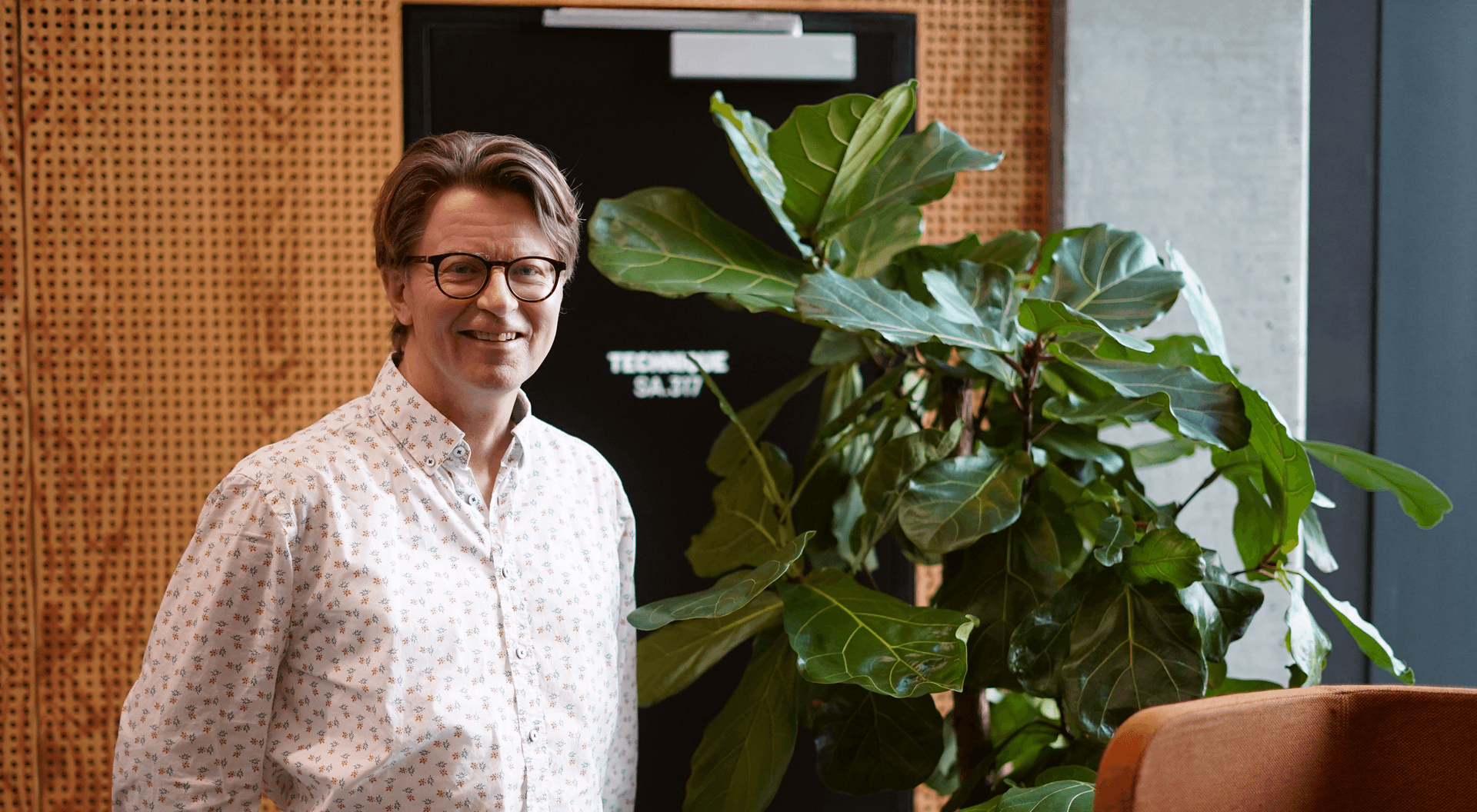
Forget the myth that innovation is only about patents and profit. In a world full of complex crises, it is the humanist who possesses the ability to ask the profound questions society craves. Meet Finn Thorbjørn Hansen, who moved philosophy from the armchair and into hospices and hospitals. Hear why "wonder-driven innovation," in particular, might be the most profound act you can perform for your research.
Imagine a river where the surface current is violent, whipped up by meetings, teaching, administration, and strategies that change direction like the wind. According to Finn Thorbjørn Hansen, Professor of Applied Philosophy, this is where the modern researcher often spends most of their time—caught in a frantic daily grind. Deeper in the river, in the middle layer, the current slows down. This is the space for periodic, closed "sanctuaries"—funded research projects where the researcher is allowed time to focus on a specific topic. Yet, even here, there is a risk of being driven around the accreditation ring, chasing the next grant or following the latest political or social trend. At the very bottom of the river, in the deepest depths, it is almost entirely still. This is the home of deep, slow thinking and basic research. It is here that the fundamental questions that originally drew us into research are allowed the peace to grow. "It is where one asks: 'What truly occupies me as a researcher, and what can actually make the world better?'" Finn explains. The tragedy of modern research, he argues, is that we spend most of our time in the surface spray and lose contact with the depths. Paradoxically, Finn’s way back into the deep was not up the stairs of the ivory tower, but out the door and into reality. He found it through innovation.
From "Wicked Problems" to "Delicate Problems"
We often hear that society is calling for solutions to "Wicked Problems"—climate change, AI challenges, and inequality—but we frequently overlook the human and existential dimensions. While the classic approach attacks these problems with new technology or policy frameworks, Finn Thorbjørn Hansen points to a deeper layer: "Delicate Problems." Take, for example, loneliness, which is a massive issue in the welfare state. Beneath the surface lie delicate questions about what it truly means to belong, and the fundamental difference between being lonely and the ability to be alone with oneself as a path to existential health. Similarly, Finn’s thesis is that the climate crisis is not just a lack of green technology, but a spiritual and cultural crisis requiring a frequently overlooked humanistic dimension. "How did we end up in such a crisis?" Finn asks. He suggests it may be a result of living according to a specific view of humanity and nature—one that is far too human-centric rather than caring for nature and the more-than-human life we are part of. Technology alone is not enough to untie this knot. Here, the humanist is indispensable for rethinking the values and perspectives on humanity that form the foundation of our society.
The Humanist’s Superpower: Standing in the Open
Many researchers fear that engaging with practice will distract them from their research, but Finn discovered the opposite. His research met reality through educators at the Design School Kolding, who saw strong parallels between Finn’s ideas on "wonder" and their own creative processes. They asked if it was possible to wonder without words. Through sketches and materials, they discovered together that wonder can also be a sensory act. This realization brought new insight to the philosopher; he saw that practitioners possessed knowledge that could challenge the depths his armchair could provide. This led to the development of the concept of "Wonder-Driven Innovation" (undringsinnovation). Here, the humanist’s particular strength is the ability to remain standing within open questions—using wonder to create resonance and meaning where systems otherwise only offer efficiency and action.
Radical Innovation Creates New Professions
For a humanist, thinking innovatively is not necessarily about inventing a new gadget. It is about creating new spaces for recognition, ethical reflection, meaningful possibilities, and concrete changes in reality. While collaborating with a hospice, Finn wondered why spiritual care was primarily left to priests and psychologists, asking: "Where is the philosopher in this equation?" This wonder was turned into action through an action research project, leading to the employment of one of Finn’s master’s students as Denmark’s first hospice philosopher. Today, Finn continues to work with concepts such as "Cultural Medicine," the "Wonder Lab," and "Breathing Spaces" (Åndehuller) in hospitals. Notably, the work with the Wonder Lab in hospice and palliative care has gained international traction; the method is now recommended in the Netherlands as an innovative way to work with existential health communication. These are dialogical and methodical tools that help patients and relatives navigate life’s most difficult transitions—creating an "existential health promotion" that cannot be measured in a spreadsheet but creates enormous value for the individual.
Master the Piano Before Making Music
If you want to develop your research while creating change, Finn offers several pieces of advice. It starts with insisting on professional craftsmanship: you must know your field inside out, just as you must master the piano before you can make music.Furthermore, one must dare to bring play into the work. Play-based learning is not trivial; it is a shortcut out of rigid boxes and into what we and our partners are actually passionate about. Finally, one must distinguish between scientific wonder, which seeks explanations, and philosophical wonder, which seeks meaning and resonance.Your research has the potential to change and improve reality, but it requires the courage to consult practice about your theory. It requires you to stand up from the armchair and say "Yes!" to the many emerging opportunities within SSH research to put humanistic insights into practice. It requires you to dare to create wonder and change in the world through your research.