The story of the building
The story of the building
The donation was so significant that it was never necessary to compromise during the project. Therefore, in every way—in terms of design, architecture, interior, and choice of materials—it has been possible to create the best conditions for everyone who will make use of the building and its facilities.
Projektets tidslinje
2015: An ambition takes shape — "A regional lighthouse for knowledge and growth and a showcase for excellent collaboration [...] with large and small companies."
June 2016: The A.P. Møller Foundation decides to donate 100 million DKK for the construction of a prominent new building, AAU Science & Innovation Hub, to house the ambition of a regional lighthouse.
Autumn 2017: COBE wins the lead consultancy tender for the AAU Science & Innovation Hub.
Summer 2019: The Danish Building and Property Agency selects MT Højgaard as the main contractor for the Science & Innovation Hub at Aalborg University.
September 2020: The foundation stone for the AAU Science & Innovation Hub is laid.
June 2021: Topping-out ceremony for the AAU Science & Innovation Hub.
July 1, 2022: The Danish Building and Property Agency hands over the Science & Innovation Hub to AAU.
August 2022: Naming competition. The building receives its nickname: AAU INNOVATE — Science & Innovation Hub.
Late summer 2022: Residents move in.
October 2022: Official opening of AAU INNOVATE — Science & Innovation Hub.
With its central location at AAU, the new building will literally function as a regional lighthouse for knowledge and growth, as well as a showcase between AAU's students and researchers on one side and small and large companies on the other.
In both its visual expression and its creative interior design, AAU INNOVATE invites collaboration, knowledge sharing, and co-creative activities between research and the business world. The building consists of offices, laboratories, meeting rooms, an auditorium, and 'garages,' making it easy to ignite interdisciplinary innovation, business ideas, and entrepreneurial dreams.
Last but not least, the building is a living expression of AAU’s vision to create new and useful knowledge for the world. For this reason, AAU INNOVATE is also open to the public.
The building features exhibition facilities that make our strengths and activities visible to the public, and there will be ongoing invitations to 'talks' and lectures on-site.
The Copenhagen-based architects, Cobe, are behind the striking framework of the new AAU INNOVATE. Read more about the architecture on Cobe’s website or in the box below.
Arkitekturen
Striking frameworks for innovation and collaboration
Cobe's proposal for an open, inviting, and dynamic building is a powerful realization of the thoughts and ideas behind the project.
In all its simplicity, the task for the construction was to create a hub as well as a showcase for interdisciplinary research, innovation, entrepreneurship, talent, and business development at Aalborg University.
This involved everything from innovation laboratories, digital workshops, and an auditorium to a canteen, incubator and office environments, and facilities for business collaboration.
In short: a coherent yet diverse building that opened up new encounters between people.
At Cobe, AAU INNOVATE has become a long, terraced building that not only adapts to the campus landscape but also creates new connections and urban density.
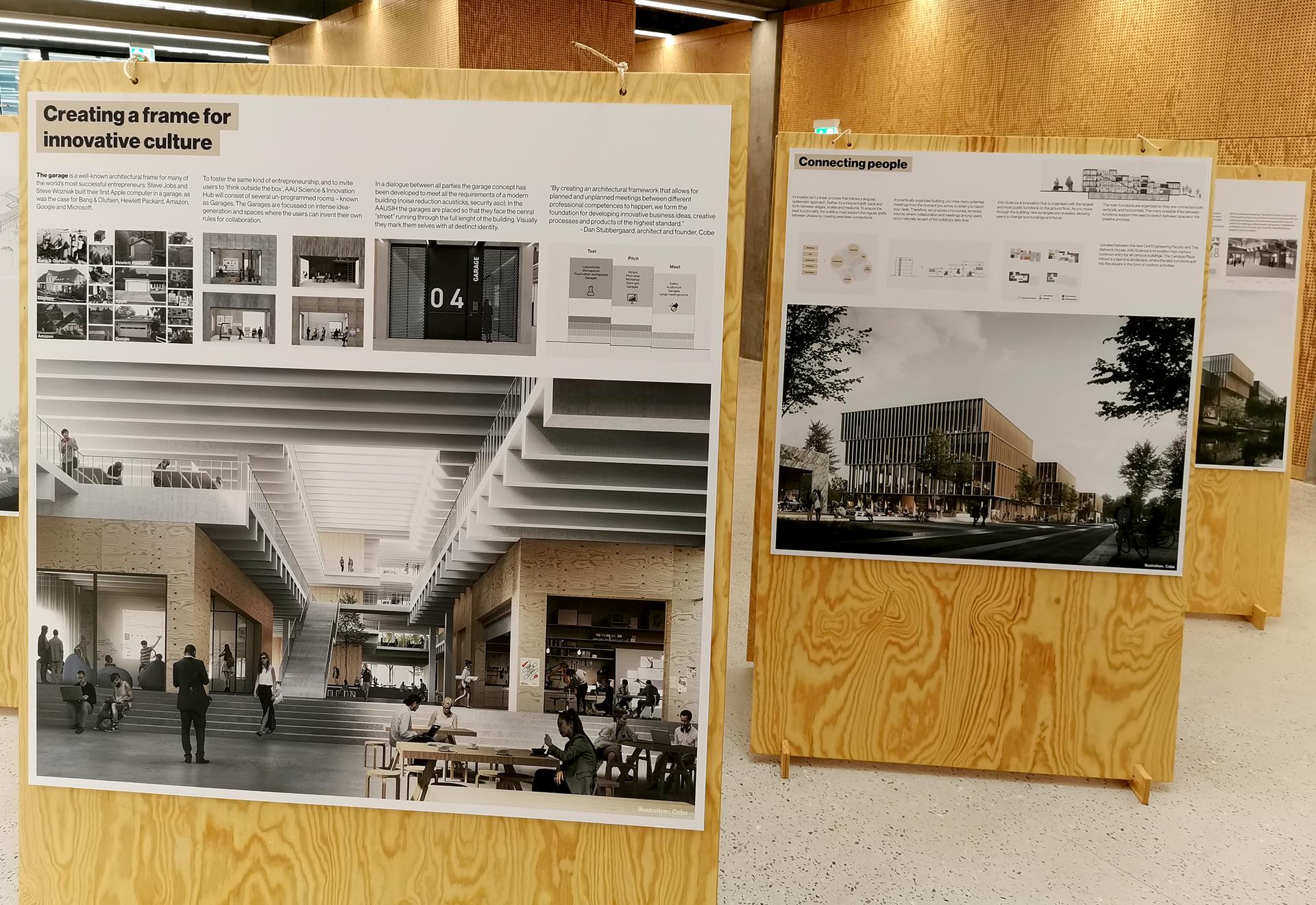
The building, which is clad in sustainable wood panels, opens up on all sides, and the elongated shape provides great opportunities to meet across the building's interior, which is organized as a multi-story street with small rooms, so-called 'garages'.
The garages, inspired by the fact that some of the world's most successful entrepreneurs started in a garage themselves, function as spontaneous meeting places where students, researchers, etc., can easily check in and brainstorm together.
Overall, the idea is that development and innovation are rarely linear processes but rather iterative and dynamic.
Therefore, AAU INNOVATE is a building that, through its design, supports the need for collaboration but also the need to change surroundings and allow space for peace and reflection, depending on where one is in the creative process.